Cooking Chapbook

Notes from my kitchen in the D.C. area & beyond

Schneeball in Rothenburg ob der Tauber
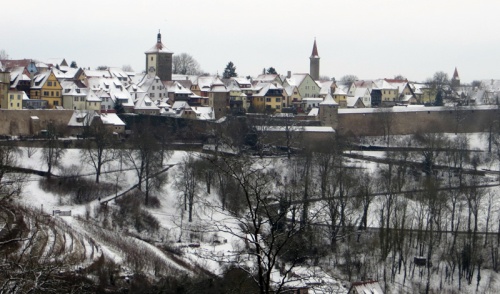
Rothenburg ob der Tauber

Rothenburg ob der Tauber, a medieval town built “above the Tauber” River.

Rothenburg ob der Tauber features a walkable medieval wall, St. Jakobskirche’s phenomenal carved wooden altar, a surprisingly interesting medieval torture museum, Germany’s largest teddy bear store (according to our highly credible shopping bag), castle gardens, and more than we could get to in a single day.

And something called the Schneeball.
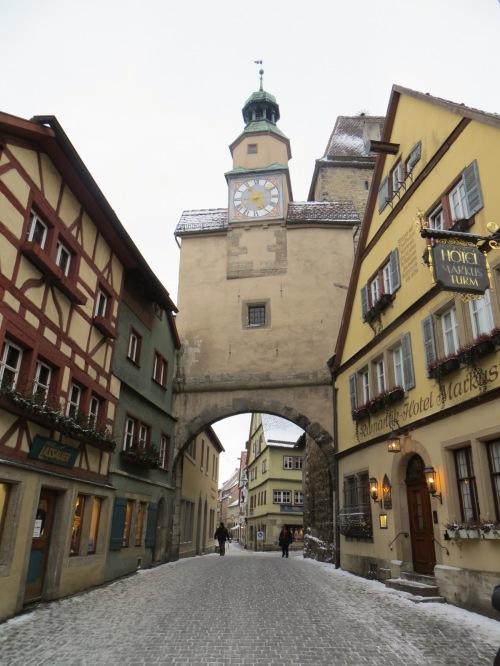
Rothenburg gate

One of the many enthralling Rothenburg gates, which give the town an almost Disney-like feel.

Here’s what Rick Steves has to say about Rothenburg ob der Tauber’s famous sweet creation:

“Unworthy of the heavy promotion they receive, Schneeballen are bland pie crusts crumpled into a ball and dusted with powered sugar or frosted with sticky-sweet glop.” (Rick Steves’ Germany 2011)

I remained intrigued.

Rothenburg cafe

A Rothenburg cafe, modern and cozy inside, with delectable treats under glass.

Schneeballen are in the windows of bakeries all around town, some coated in chocolate, others plain. I liked the snowy look of the ones powdered with sugar.

We found an elegant cafe by the Market Square and settled in to try one for ourselves.
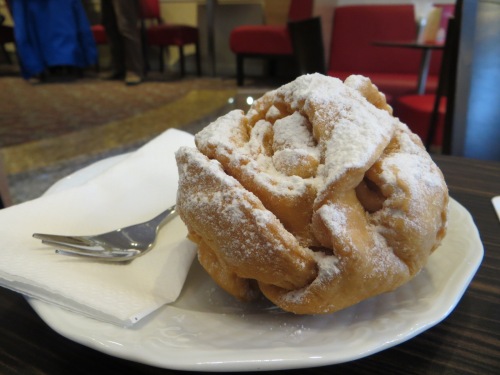
Schneeball

A Schneeball, dusted with powered sugar.

And, well. If you are a pie-crust fanatic, you will be in the land of bliss.

But otherwise: Rick is right. It’s rather crisp and dry, not very tantalizing. I wouldn’t order one again.

Maybe the chocolate variety. Just to be sure.

The best use I found for the pastry bits, once broken apart, was to dunk them in tea like a springerle cookie. Most every hard and purportedly sweet German treat is better softened in tea, warmed up and dreamy.
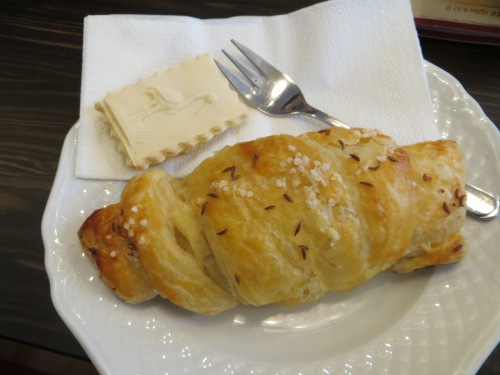
Croissant and springerle cookie

A cheese-ham croissant and a springerle cookie, imprinted with an elegant bird.

But even then, the schneeball is not truly ideal. This cafe also sold its own springerle cookies, which were beautifully imprinted with detailed animals. And even better dunked in hot tea.
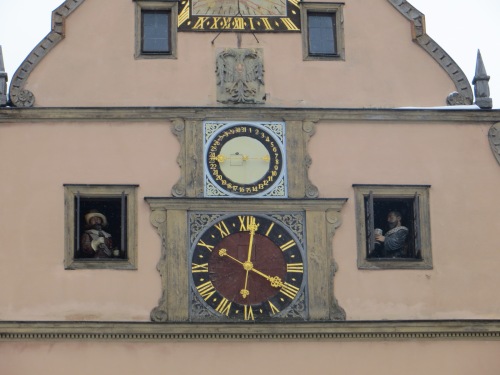
Rothenburg clock man

Rothenburg clock man, at right, just downed his mug of beer to save the day.

Outside the cafe, in the Market Square, the Meistertrunk story is re-enacted regularly by the figure on the square’s clock tower. Legend – apparently unfounded, but a nice tale fit for tourists – has it that in 1631, the mayor saved the town from invaders by meeting an army general’s dare and drinking an entire three-liter mug of beer in one gulp.

And so, on the hour most hours starting at 11 a.m., the mayoral figure lifts his beer mug to the delight of the watching crowd.

About as exciting as a ball of pie pastry.

Rothenburg in the snow

Rothenburg in the snow, a fairytale town.

Still, I wouldn’t skip these little tourism routines. Each town has its own scripts and props, an adorable formality of hospitality on the travel circuit. The oddity brings a light thrill of its own.

And altogether, Rothernburg ob der Tauber was enthralling, a fortress in snow white high above the rushing river. Visiting out of season means watching the museum/church times closely and missing the night watchman’s tour. But what you get in return is a mystical stillness, like walking through a storybook setting, where the only snowballs are edible.
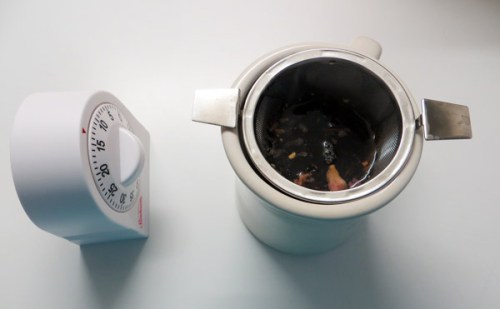
Magic tea in February

Time the tea

I believe it may be time for tea.

February. Oh, I could do without you.

Your quietness exhausts me. Your monochromatic skies bore me. Your snowy lint irritates me.

But then, my dry hands cradle a cup of hot liquid. My tight shoulders loosen a centimeter. Then two. The first scalding sip warms my throat, my belly, my bones.

If December is all glüwein and hot chocolate, and January is fit for resolutions and a motivating cup of joe, February is the perfect month to reacquaint yourself with tea.

Oh, tea. In the middle of a blazing summer, I forget how much I like you.

February, I must grudgingly admit, reminds me.

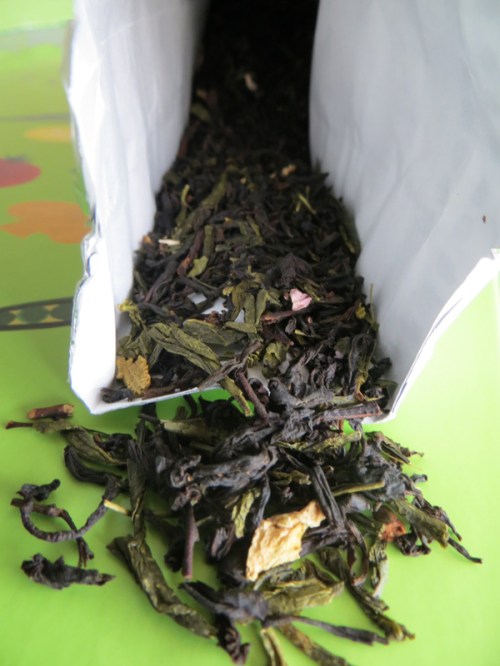
Magic tea leaves

Magic tea leaves

Let’s talk about tea leaves.

Like many things, at first, I did not understand. Why not a tidy little bag? Why not a string? Why bother with a pile of dried, crackly leaves and things? Why wrestle the soggy mess out of a ball of a strainer?

But, like so many things, millions of people know something I don’t. Tea tends to be fresher when it’s loose. More carefully handled. Better.

It only takes one cup of brightly brewed loose-leaf tea to shock the system. And herald a conversion.

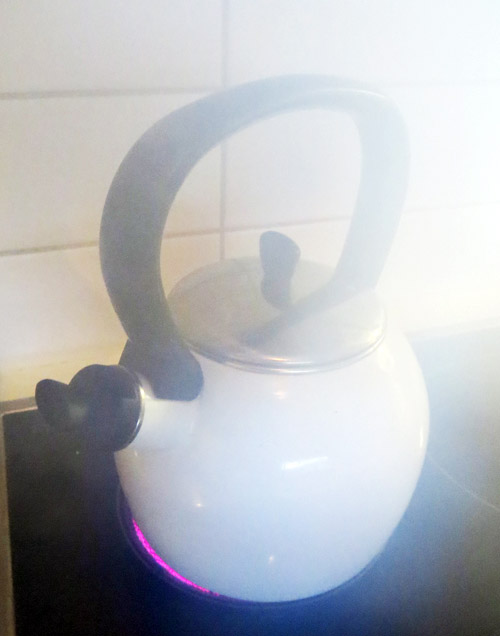
Teapot sings ready now

Teapot sings: “Ready now!”

There’s a lovely little tea store in Stuttgart that has become a fixture on my visitor circuit. I bring visitors to the Schlossplatz (palace square) and the Königstrasse (king street).

And then we go buy tea.

The batch pictured above is called Micraculix Zaubertee, which the tea lady translated as magic tea.

Made of black tea, green tea, mistletoe, and rose petals, the tea is named so because it tastes differently to different people, she told me. Perhaps it resembles green tea to you, and black tea to your friend.

Tea, steeping

Shhh. The tea is steeping.

To me, it tastes like a sweet, floral green tea, a more palatable version of the straight-up green tea.

Chai is also lovely, with a dollop of milk and spoonful of brown sugar.

Pretty tea leaves

A rose by any other name would taste as sweet.

I’m not yet a tea scientist. I haven’t figure out the exact temperature and timing.

Some days, the tea is slightly bitter or grassy.

Other days, it’s as bright and sweet as an apple.

As temperamental as the weather.

Part of me rather likes not knowing how it will turn out.

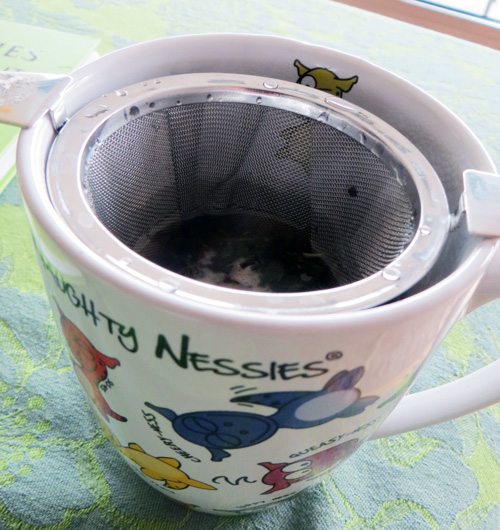
Tea strainer

All ready?

This cup comes from Scotland, via one of my most cherished friends. All sorts of “nessies” dance around the cup. Not Loch Ness himself, but his unsung incarnations: Cheery-Ness, Tired-Ness, Queasy-Ness. My favorite is Wonder-Ness.

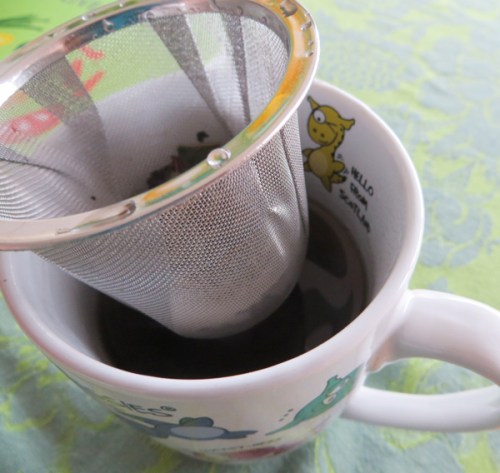
Hello from Scotland mug

Tea is best served with a little sweetness.

And February, you might well be Dreary-Ness.

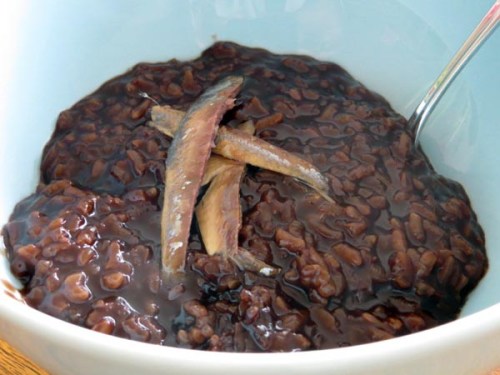
Champorado, Filipino chocolate rice pudding

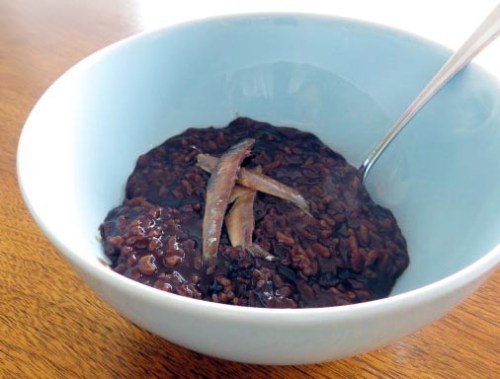
Champorado, Filipino chocolate rice

Champorado, Filipino chocolate rice

Of all the Filipino foods I know so far – maybe 0.1% of the lexicon – the one that baffles me is champorado. I love chocolate. I love rice pudding. I love salty little fish. And yet …

Essentially chocolate rice pudding, champorado is thick, warm, deeply chocolate, and often served with salty, dried fish. For breakfast. Perhaps you can understand my confusion. Or perhaps you are in my sweetheart’s camp.

He loves it, adores it, craves it. We’re too far right now for his mother to cook up a delicious batch, so I thought I’d try to stir up a bowl for his birthday.

Ingredients for Champorado

Ingredients for champorado

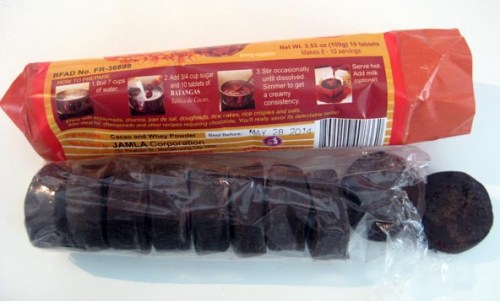
His family had months ago given us cocoa tablets and a jar of tuyo, the tiny fish. They were sitting in the cabinet, watching the cans of tomatoes and coconut milk come and go, and patiently waiting for their day under the stove light.

Ingredients for Champorado

Cocoa tablets for champorado

My sweetheart thought I could use our everyday white long-grain rice, but none of the many recipes I checked out, including the one his mother kindly sent, mentioned ordinary rice. And this champorado would be like a birthday cake! It called for special-occasion rice: short-grain, sticky, sweet rice.

Rice cooking for Champorado

Rice soaking for Champorado

Sweet rice needs to be soaked for 20 minutes or so before you cook it. The nice part is no extra dish is required. I poured 1 cup of sweet rice in a small pot, covered it with 1 1/3 cup water, and let it sit.

Rice cooking for Champorado

I love the little designs the pebbles of rice make.

Then I cranked up the heat until the water boiled. Once it was boiling, I turned it down to the lowest setting, covered the pot, and let the rice cook for another 15 minutes or so.

Meanwhile, in another small pot, I boiled 2 cups of water. Then I added 3 tablets and 1/4 cup sugar. I let it bubble and simmer and break down while the rice cooked.

Once the rice was done, I mixed in the pot of chocolate into the rice to make a rich porridge.

Champorado

Champorado

I let the rice pudding simmer until it cooked down a little bit. You can cook it longer, if you’d like more water to absorb.

Eat it with dried fish, if you like. Some of my favorite people do.

Champorado, Filipino chocolate rice

Champorado, Filipino chocolate rice

Chocolate Scrabble

Chocolate Scrabble. Clearly genius. And the best White Elephant gift ever.

Chocolate Scrabble box

Chocolate Scrabble box

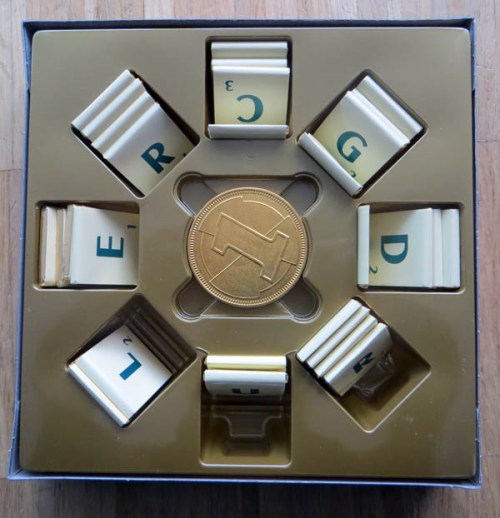
Yes, the pieces are chocolate. Let’s look inside!

Chocolate Scrabble, inside the box

Chocolate Scrabble, inside the box

Inside the box, you’ll find wrapped chocolates marked with letters. The “coin” in the middle is also chocolate, and the game’s designated reward for the winner. Yes, you apparently are only supposed to play Chocolate Scrabble once.

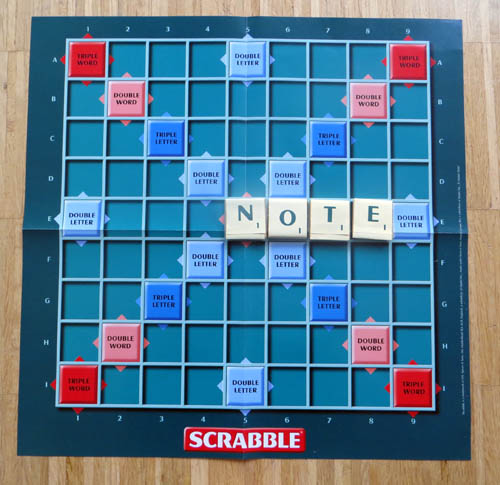
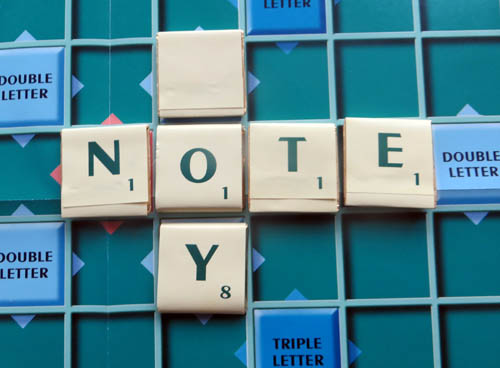
Take note of Chocolate Scrabble!

Take note of Chocolate Scrabble

Since it’s a one-shot game, the board is foldable slick paper. And Scrabble geeks may be in shock – there are no tile holders. You are, I can only imagine, supposed to keep your tiles in view of the other players. I know!

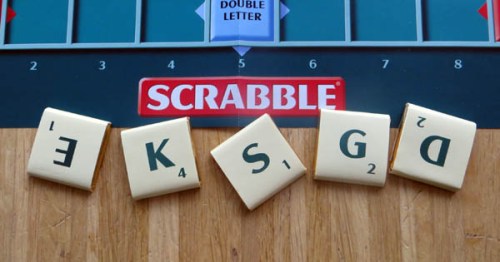
Five sample letters of Chocolate Scrabble

Five sample letters

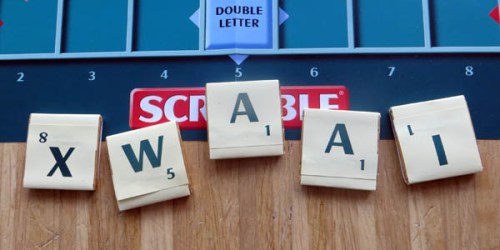
The differences don’t end there. The directions direct each player to pick out five letters (rather than the usual seven), except each tile has a front and a back …

Five sample letters flipped

Five sample letters flipped

… so E on one side might be X on the other.

Chocolate Scrabble's blank space

Chocolate Scrabble’s blank space

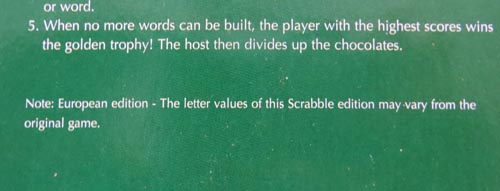
Yes, there are blanks. But I was most aghast to find the Y letter worth 8 points. In usual English Scrabble, Y = 4 points. (Scrabble fans may have also noticed above that the W is 5, instead of 4.) What is happening?

Chocolate Scrabble is a European specialty

Chocolate Scrabble is a European specialty

You probably also want to know how the chocolate tastes. I confess, we have played the game twice, and I can’t bring myself to eat the tiles yet. I know we must. The time is coming. I’ll let you know …

And after the chocolate tiles are gone, I’m thinking it may be time to make a homemade edible Scrabble version, maybe with hard German cookies. Any ideas?